The Physical Remnants of Hengist and Horsa
Hengistbury Head and the White Horse of Kent
Among the most enduring figures connected with the beginnings of the early English kingdoms are the brothers Hengist and Horsa. Traditionally described in sources such as the Anglo-Saxon Chronicle and the 8th-century writings of the Venerable Bede, the two warrior leaders were said to have arrived in Britain during the collapse of Roman authority in the 5th century, initially as mercenaries before becoming founders of early Saxon power in southern Britain.
Whether entirely historical, partially legendary, or later mythologised ancestors, the memory of Hengist and Horsa appears to survive not only in texts, but possibly in the very landscape and symbols of southern England itself.
Hengistbury Head — “Hengist’s Burgh”?
Hengistbury Head is one of the most strategically important prehistoric and early historic coastal sites in Britain. Situated between Christchurch Harbour and Bournemouth Bay, the headland commands views across the Solent approaches and toward the Isle of Wight.
Its very name has long invited comparison with Hengist himself.
The modern name “Hengistbury” is usually interpreted as deriving from Hengestesburh — literally “Hengist’s fortified place” or “Hengist’s burgh.” While definitive proof is impossible, the survival of such a name attached to such a significant coastal stronghold has fascinated historians for centuries.
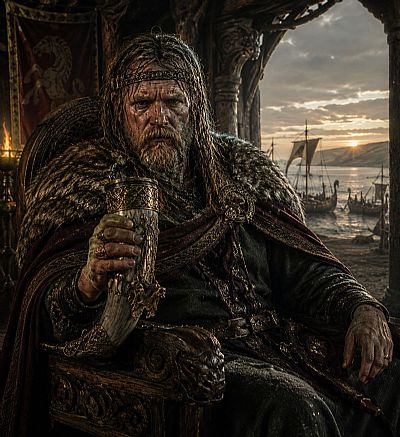
The Old English word burh (burgh/bury) referred to a fortified settlement or defended place. Thus, “Hengistbury” may preserve a very ancient folk memory linking the headland with an early Saxon war leader or ruling dynasty.
A Strategic Coastal Fortress
Long before the Saxons arrived, Hengistbury Head was already ancient.
Archaeology has revealed extensive Bronze Age and Iron Age occupation, including defensive earthworks, settlement traces, and evidence of large-scale trade. The headland controlled access to the sheltered waters of Christchurch Harbour and sat close to navigable river systems leading inland into Wessex.
In antiquity, the coastline looked dramatically different from today.
Sea levels during parts of the late prehistoric and Romano-British periods were lower than modern levels, while centuries of coastal erosion had not yet eaten away substantial parts of the headland. The area would likely have presented a broader, more substantial promontory with easier access to surrounding lowlands.
This made it an ideal harbour and staging point for maritime peoples crossing the Channel or moving along the south coast.
Iron Production and Trade
One of Hengistbury Head’s greatest ancient resources was iron.
Archaeological investigations have uncovered evidence for extensive ironworking and trade activity. During the Iron Age, the region was heavily involved in metal production and exchange networks extending across the Channel into Gaul.
The nearby heathlands and bog-iron deposits provided accessible raw materials, while the harbour enabled movement of goods by sea. Finds from the site include imported Mediterranean and continental goods, demonstrating that Hengistbury Head was connected to surprisingly wide trade routes centuries before the Anglo-Saxon period.
Some historians have suggested that such long-standing maritime and trading connections may help explain why Germanic mercenary groups later found southern Britain both familiar and strategically attractive.
A Gateway Into Wessex
The headland’s geography also places it directly within the broader region later associated with the rise of the West Saxons.
The sheltered waters stretching from Christchurch Harbour toward the Solent form one of the most navigable coastal corridors in southern England. In an era where sea travel was often faster and safer than overland movement through forests and marshes, such landing places were immensely valuable.
It is therefore unsurprising that later traditions connected major early Saxon leaders with this coastline.
Nearby archaeological and defensive sites — including Badbury Rings and the reused defensive earthwork of Bokerley Dyke — demonstrate that this landscape remained strategically significant long after Rome’s withdrawal.
Horsa and the White Horse of Kent
While Hengist may survive in the landscape of Dorset, Horsa may survive symbolically in Kent itself.
The kingdom traditionally founded by Hengist and Horsa was the Kingdom of Kent. One of Kent’s enduring emblems is the famous White Horse.
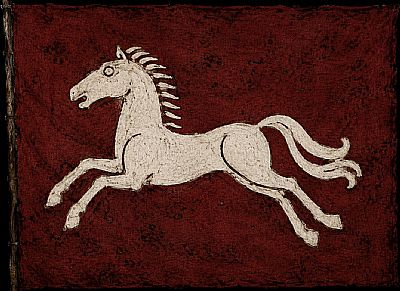
The Kentish white horse banner — today strongly associated with the word Invicta (“unconquered”) — is often believed to preserve extremely ancient Germanic horse symbolism.
The connection becomes especially interesting because the name “Horsa” itself literally means “horse” in Old English.
Thus the paired brothers carry deeply symbolic names:
Hengist = “stallion”
Horsa = “horse”
Many scholars believe these names may originally have possessed mythic or dynastic significance rather than being ordinary personal names. Horse imagery was sacred and prestigious among Germanic peoples, associated with kingship, warfare, fertility, and divine favour.
The white horse standard of Kent may therefore represent not merely a medieval heraldic emblem, but a distant echo of the early warrior traditions associated with Horsa himself.
The Horse in Germanic Tradition
Horse symbolism appears repeatedly across the Germanic world.
The 8th-century historian Bede specifically names Hengist and Horsa as leaders of the first Germanic settlers invited into Britain. Elsewhere in northern European tradition, sacred horses appear connected to divine ancestry and royal legitimacy.
The white horse in particular became a recurring emblem among Saxon and related peoples. This survives not only in Kent, but also in chalk hill figures such as the famous Uffington White Horse, whose origins predate the Saxons but demonstrate the deep ritual importance of horse imagery in Britain itself.
Some historians have even proposed that the Hengist-Horsa story may preserve fragments of a much older Indo-European “divine horse twins” myth tradition adapted into early English origin legends.
Between Myth and Memory
Modern historians remain cautious about treating Hengist and Horsa as straightforward historical individuals. The surviving written accounts were compiled centuries after the events they describe, and legend undoubtedly shaped the narratives.
Yet legends often attach themselves to real places, real dynasties, and real cultural memories.
Hengistbury Head remains one of the most important ancient coastal strongholds in southern Britain. The White Horse of Kent remains one of the oldest continuously used regional emblems in England. Together they form intriguing physical and symbolic remnants connected with the shadowy beginnings of Saxon England.
Whether Hengist and Horsa were historical warlords, mythologised ancestors, or symbolic founders, their memory still lingers — in the landscape of Wessex and in the banner of Kent.